
TOOLS
Tool 1 – Book of Understanding #1 (Confusion Dump)
Have you ever been told to write down everything you’re confused about?
Probably not.
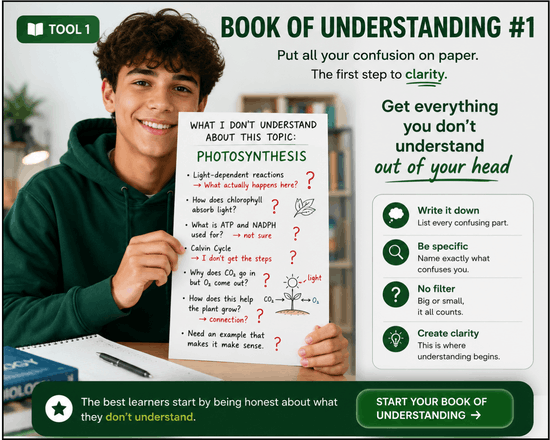
So how could we ever get to the point of actually examining our confusion? The Confusion Dump starts by doing the opposite. Pick one subject you want to understand better. Then write down everything about that subject that confuses you. Don’t stop after the first few things. Write every confusing word, idea, definition, instruction, missing step, assumption, contradiction, or question you can think of. Keep writing until you honestly cannot think of anything else about that subject that confuses you. Don’t try to answer the questions yet. Don’t judge them. Don’t worry if some seem basic. Just get the confusion out. Many people report that simply putting all of that confusion onto paper has a calming effect. What felt like one giant cloud in your head can start looking like individual questions and problems that can actually be worked through. This is why the C in CLEAR stands for Confront Your Confusion. The word Confront is intentional. It is a direct pushback against the idea that confusion should be hidden or treated as shameful. Instead of pretending you understand, you turn around, face the confusion, and ask: “Okay. What exactly don’t I understand?”
How can it help? Use it when one subject feels overwhelming, when you don’t know where to begin, or before asking someone for help. Once the confusion is visible, you have a much clearer starting point.
Why it works:
You can’t work through confusion you haven’t identified. By focusing on one subject at a time and continuing until you’ve emptied out everything you can think of, a vague feeling of “I don’t get this” becomes a list of specific things you can investigate, question, and eventually understand.
Tool 2 – Book of Understanding #2 (Learning Process Tracker)
Learning is not something you either get or don’t get. It is a process.
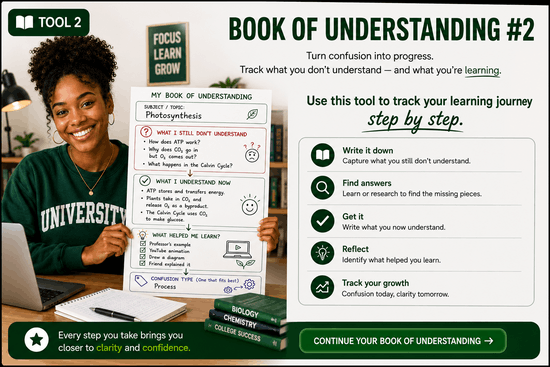
This tool helps learners record what confused them, what they tried, what finally helped, and what they understand now.
Over time, they are not only learning the subject. They are also learning how they learn.
The goal is to move away from thinking:
“I’m just bad at this.”
And toward asking:
“What part don’t I understand yet, and what helps me understand it?”
The Book of Understanding becomes a record of the learning process, including the struggles, questions, breakthroughs, and methods that helped.
How can it help?
Students, self-learners, employees, and trainees can use it to follow their progress instead of judging themselves based on one difficult moment.
Why it works: Seeing learning as a process encourages persistence and helps people discover the methods that work best for them.
Tool 3 – Tree of Inquiry
Think about how children naturally learn.
They ask a question. The answer often creates another question. That answer creates another one.
Why? How? What happens next??
The Tree of Inquiry helps learners return to that naturally inquisitive state of mind.
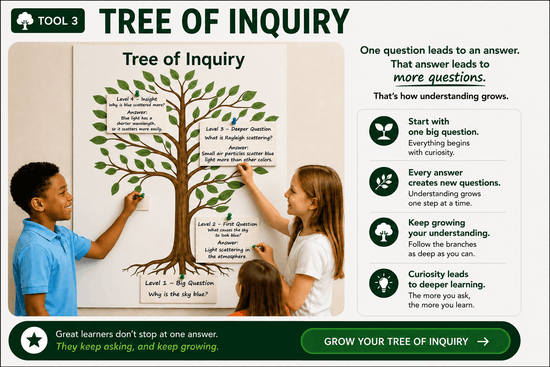
Start with one question and follow where it leads. Questions produce answers. Answers produce new questions. Those questions lead to more answers.
The goal isn’t simply to reach one final answer. It is to experience inquiry as a process.
You may begin by trying to understand one small thing and discover an entire branch of ideas you had never considered.
How can it help? Use it for studying, research, brainstorming, exploring a new subject, or anytime you want to understand something beyond the surface.
Why it works: Deep learning rarely comes from one question and one answer. Curiosity creates a continuing chain of questions, answers, discovery, and deeper understanding.
Tool 4 – Clarometry
“I don’t understand” is important, but it doesn’t tell you what kind of confusion you’re experiencing.
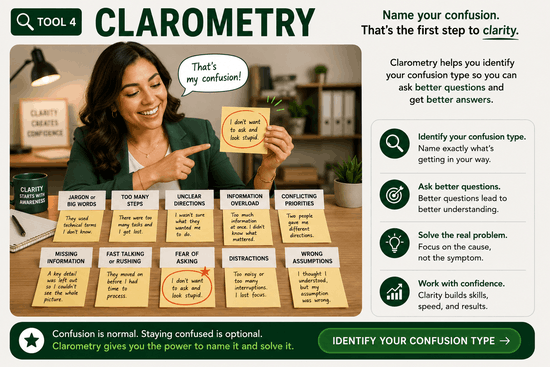
Clarometry introduces the idea that confusion can be identified and classified.
Are you confused by a word? A definition? A step? An assumption? An instruction? Are two ideas contradicting each other? Is important information missing?
Learning to classify confusion may be one of the biggest steps toward finding the answer.
It changes the question from:
“Why don’t I get this?”
to:
“Exactly what don’t I get?”
Once you can identify the type and source of the confusion, you have a much better chance of asking the right question.
How can it help? Use Clarometry whenever you know something isn’t making sense but have trouble explaining exactly what is wrong.
Why it works:
The more precisely you can describe confusion, the easier it becomes to ask the question that can resolve it.
Want to see more examples of different types of confusion?
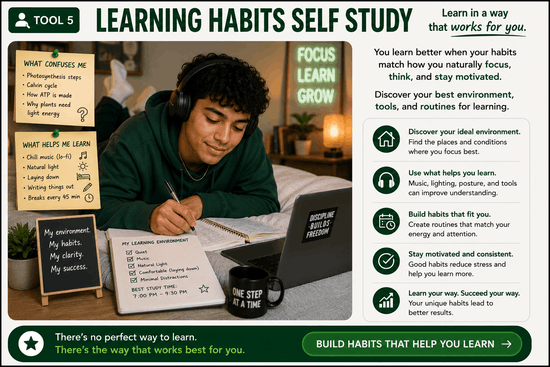
Tool 5 – Learning Habits Self Study
This tool isn’t simply about developing “good study habits.” It helps you investigate how you personally learn best.
Do you understand something better when you see it? Hear it? Try it yourself? Watch someone demonstrate it?
Does practical application make an idea finally click?
Do you learn better somewhere quiet? Around other people? In short sessions? Through repetition?
What environment makes it easier for you to concentrate?
The learner becomes the subject of the study.
How can it help? Use it to explore your learning preferences, environment, routines, distractions, practical application, and the conditions that help you understand and remember information.
Why it works:
When people understand how they learn, they can make better choices about how they approach new information.
Tool 6 – Reformulate Now Tracker
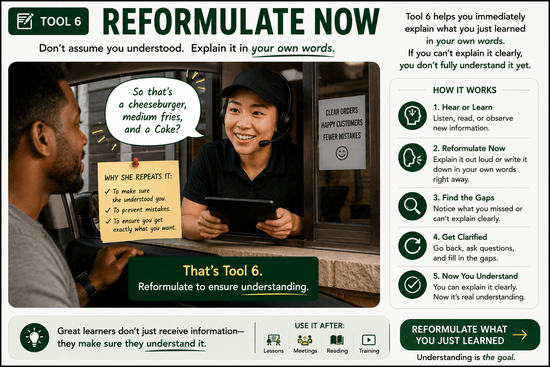
Reformulation can be as simple as the drive-through.
You place an order. The employee repeats it back. You confirm that what they heard is what you meant.
Learning can work the same way.
After receiving new information, the learner explains it back in their own words.
This creates a kind of mirror effect between learner and teacher. The teacher gets to hear what actually reached the learner instead of assuming the message was understood exactly as intended.
The same principle can be extremely valuable at work. An employee repeating instructions in their own words gives both sides an opportunity to find misunderstandings before they become expensive everyday mistakes.
How can it help?
Use it after lessons, instructions, meetings, training, assignments, or important workplace directions.
Why it works:
Repeating information back exposes the difference between what was said and what was actually understood.
Tool 7 – AI Learning Tools
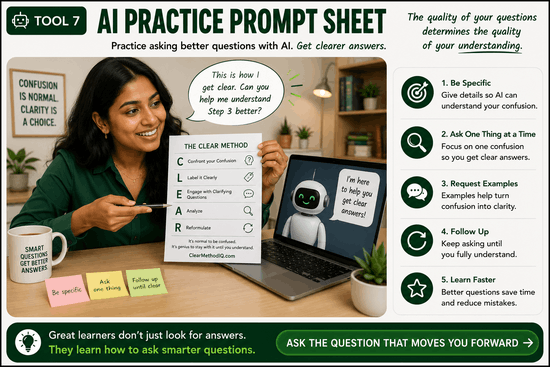
AI creates an unusual opportunity for learning:
You can be confused without feeling embarrassed about it.
AI doesn’t roll its eyes. It doesn’t get frustrated because you asked the same question again.
You can ask it to explain something more simply. Ask for another example. Tell it you still don’t understand. Ask it to compare two ideas. Ask it to explain something as if you were younger or completely new to the subject.
It can even test you based on your answers, find what you still don’t understand, explain it again, and continue until you have worked through the subject.
This tool provides useful prompts and tips for turning AI into a patient learning assistant rather than simply an answer machine.
How can it help? Use the prompts to ask better questions, request clearer explanations, practice a subject, test yourself, explore ideas, and learn at your own pace.
Why it works:
AI gives learners a rare low-pressure opportunity to keep saying “I still don’t understand” until they finally do.
Tool 8 – Class or Team Confusion Survey
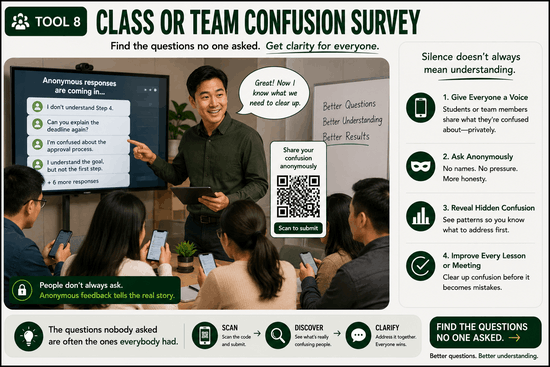
Teachers and managers cannot fix confusion they never hear about.
This tool gives students or employees a private way to report what they don’t understand.
The survey can be used every day, once a week, once a month, after training, or whenever important new information is introduced.
That flexibility matters because confusion doesn’t happen on a schedule.
Instead of waiting until confusion appears as a failed assignment, poor performance, frustration, or an expensive workplace mistake, the teacher or manager gets an opportunity to discover it earlier.
How can it help?
Ask students or employees privately what remains unclear after a lesson, meeting, training session, policy change, new procedure, or assignment.
Why it works:
Private feedback can reveal confusion that people may never feel comfortable admitting in front of a class, manager, teacher, or group.
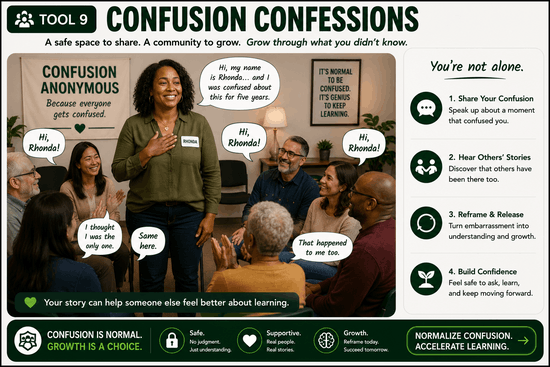
Tool 9 – Confusion Confessions & Reframes
One reason people hide confusion is surprisingly simple:
They think everybody else understands.
A student may sit in a classroom believing they are the only person who is lost. An employee can feel exactly the same way during a meeting or training session.
Confusion Confessions & Reframes gives groups a structured opportunity to acknowledge confusing moments and change how they talk about them.
Someone may discover that the question they were embarrassed to ask was the same question several other people had.
That can completely change how confusion feels.
Instead of being evidence of personal failure, confusion becomes something people recognize as a normal part of learning.
How can it help? Use it with classrooms, teams, workshops, training programs, meetings, or other groups where people may hesitate to admit they don’t understand.
Why it works: Discovering that other people are confused too reduces isolation and can make everyone more comfortable asking questions.
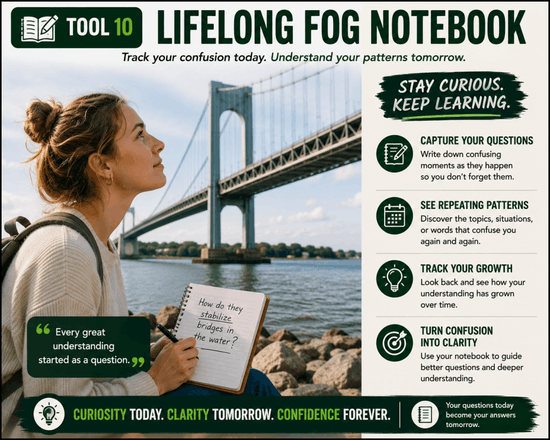
Tool 10 – Lifelong Fog Notebook
Some questions disappear after five minutes. Others stay with us for years.
The Lifelong Fog Notebook gives you one place to keep questions, unclear ideas, discoveries, and moments when something finally makes sense. Instead of forgetting a question because you cannot answer it today, you can save it and return to it later.
Over time, the notebook becomes a personal record of how your understanding has changed.
How can it help? Use it for subjects you are learning over long periods, personal questions, professional development, or anything you want to understand more deeply.
Why it works: Keeping unanswered questions alive gives curiosity somewhere to go, while looking back at old confusion makes progress visible.
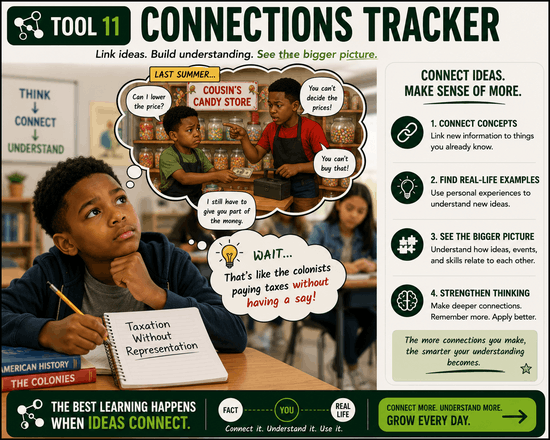
Tool 11 – Connections Tracker
New information is easier to understand when you can connect it to something you already know.
This tool helps learners take a new idea and find links to past experiences, familiar ideas, examples, other subjects, or things they already understand.
Instead of treating every new idea as isolated information, you begin building a network of understanding.
How can it help? Use it when new information feels difficult to remember or disconnected from everything else you know.
Why it works: Meaningful connections give your brain more ways to understand and remember information.
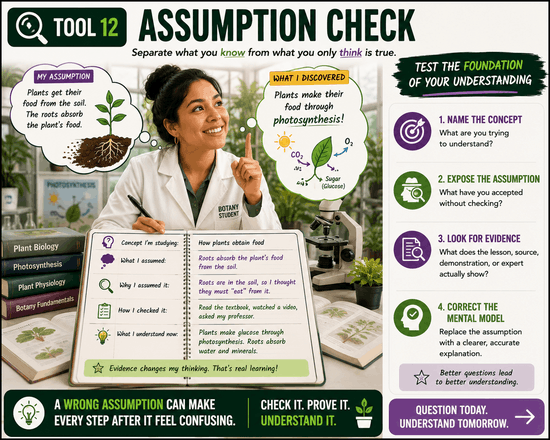
Tool 12 – Assumption Check
Sometimes the problem isn’t what we don’t know. It’s something we think we know but never checked.
This tool helps you identify assumptions, write them down, examine the evidence behind them, and decide what needs to be verified before moving forward.
How can it help? Use it before making an important decision, beginning a project, solving a problem, or acting on information that might be incomplete.
Why it works: Finding a bad assumption early can prevent confusion, wasted time, and mistakes later.
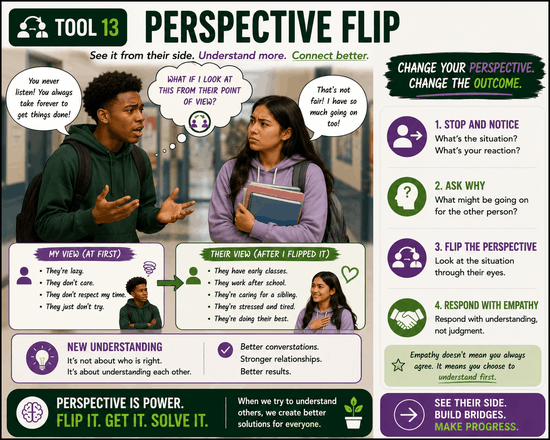
Tool 13 – Perspective Flip
Two people can experience the same situation and understand it completely differently.
Perspective Flip asks you to temporarily look at a problem through someone else’s eyes.
What information do they have? What might they be missing? What are they trying to accomplish? What could they understand differently than you?
How can it help? Use it during disagreements, teamwork, group projects, workplace communication, or whenever another person’s reasoning is difficult to understand.
Why it works: A different perspective can reveal information, assumptions, and possible solutions that aren’t obvious from your own point of view.
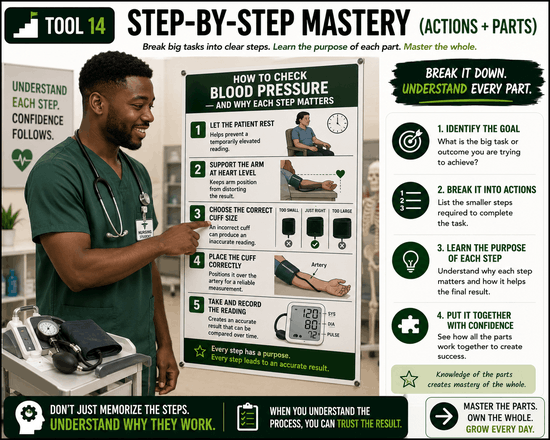
Tool 14 – Step-by-Step Mastery (Actions + Parts)
A large goal can feel impossible when everything is presented at once.
This tool helps you take something complicated and separate it into its individual parts.
Those parts can then be turned into smaller actions that can be understood and completed one at a time.
How can it help? Use it for projects, studying, complicated instructions, workplace tasks, business planning, or anything that feels too big to know where to begin.
Why it works: Smaller steps make it easier to identify what you understand, what you still need to learn, and exactly what comes next.
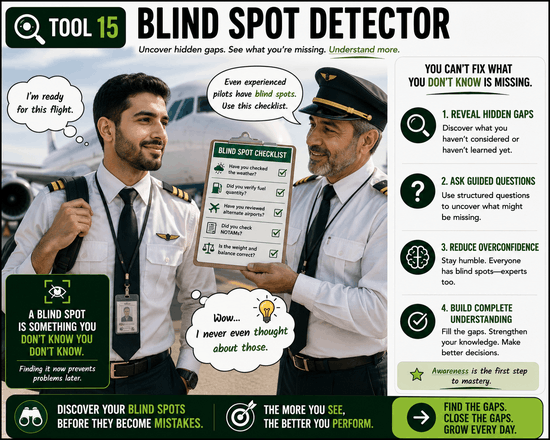
Tool 15 – Blind Spot Detector
Sometimes the most important thing you’re missing is something you don’t realize you’re missing.
The Blind Spot Detector encourages you to deliberately search for unanswered questions, missing information, weak assumptions, overlooked details, and areas where your understanding may not be complete.
How can it help? Use it before a test, project, presentation, decision, meeting, or important piece of work.
Why it works: Looking for gaps before they become problems gives you an opportunity to correct them early.
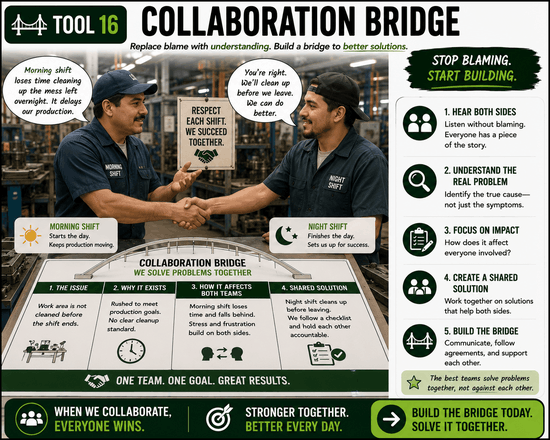
Tool 16 – Collaboration Bridge
People can think they agree while actually working from different definitions, assumptions, expectations, or understandings.
Collaboration Bridge gives people a structured way to explain what they understand, compare their thinking, ask questions, and work toward a shared understanding before moving forward.
How can it help? Use it for classrooms, teams, meetings, group projects, workplace training, and collaborative problem-solving.
Why it works: Collaboration becomes much easier when people understand both the task and each other.
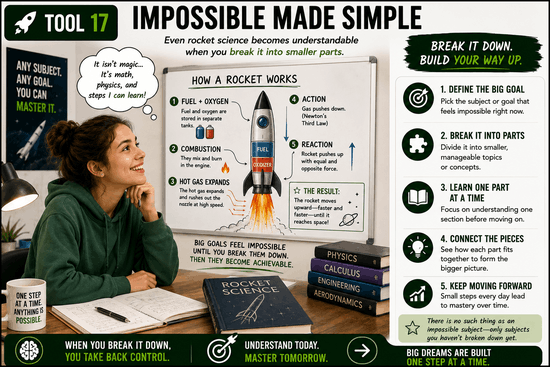
Tool 17 – Impossible Made Simple
Sometimes a subject feels impossible because too many unfamiliar ideas are being presented at the same time.
This tool helps you break difficult information into smaller pieces that can be examined and understood individually.
Instead of saying, “I don’t understand any of this,” you can begin finding the exact piece where understanding stops.
How can it help? Use it when a lesson, process, instruction, or subject feels so complicated that you don’t know where to start.
Why it works: Breaking complexity into manageable pieces turns one overwhelming problem into several smaller problems you can actually work on.
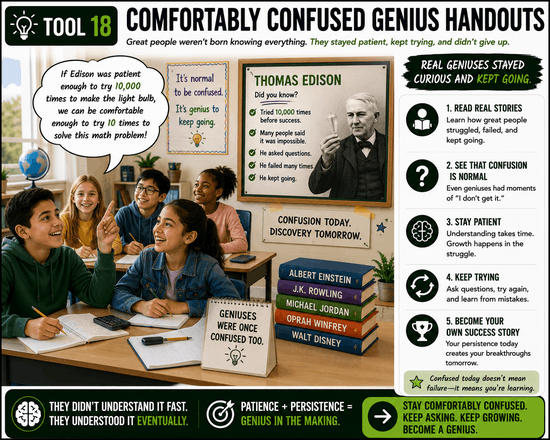
Tool 18 – Comfortably Confused Genius Handouts
Being smart does not mean understanding everything immediately.
These handouts use examples, stories, and reminders to show that highly successful and intelligent people have also experienced uncertainty, asked basic questions, made mistakes, and struggled to understand things.
The goal is to separate intelligence from instant understanding.
How can it help? Use the handouts in schools, workplaces, workshops, training programs, or anywhere people may feel embarrassed about not knowing something.
Why it works: When confusion stops feeling like evidence that someone isn’t smart, people are more willing to keep learning.
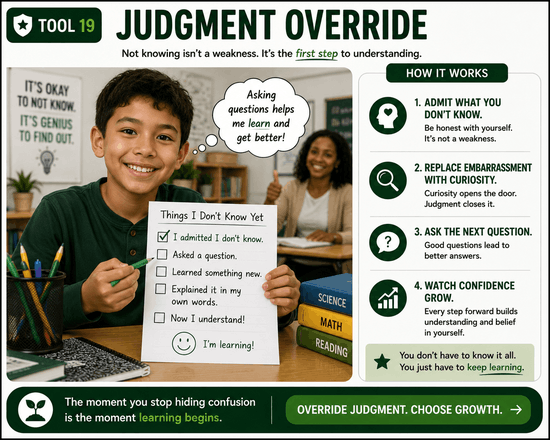
Tool 19 – Judgment Override
Sometimes the question is ready, but fear stops it from coming out.
People may worry that their question sounds stupid, that everyone else already knows the answer, or that someone will judge them for not understanding.
Judgment Override helps learners recognize that fear and choose understanding over protecting their image.
How can it help? Use it before asking a question in class, speaking during a meeting, requesting clarification, or admitting that something doesn’t make sense.
Why it works: Reducing fear makes it easier to ask the questions that learning requires.
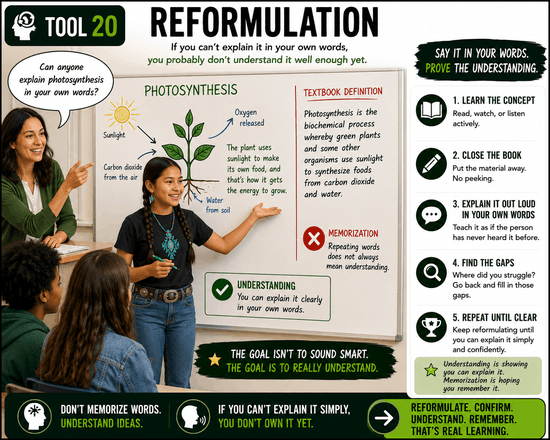
Tool 20 – Reformulation
Recognizing information is not the same as understanding it.
Reformulation asks you to take what you’ve just learned and explain it again in your own words.
You can then compare that explanation with the original information and with what you believed before.
This makes understanding something you can actually check instead of simply assuming it happened.
How can it help? Use it after a lesson, reading assignment, training session, video, conversation, or explanation.
Why it works: If you can accurately explain an idea in your own words, you have much stronger evidence that you understand it.
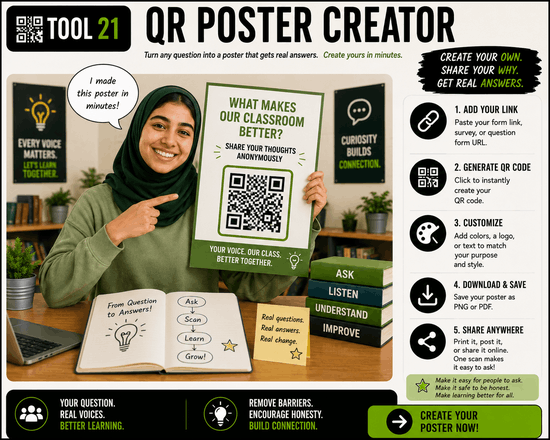
Tool 21 – Anonymous Question QR Poster
Raising your hand isn’t comfortable for everyone.
This tool lets a teacher, manager, trainer, or organization display a QR poster that gives people another way to submit questions privately.
Someone who would never say “I don’t understand” in front of a room may be perfectly willing to type the question privately.
How can it help? Place it in classrooms, training rooms, meetings, workplaces, or other shared spaces where questions are important.
Why it works: Giving people another way to communicate can uncover confusion that might otherwise stay hidden.
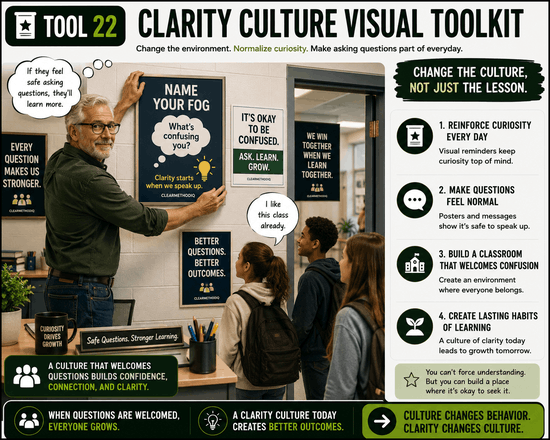
Tool 22 – Clarity Culture Visual Toolkit
You cannot create a culture where questions are welcome by saying “ask questions” once.
This toolkit uses posters, graphics, reminders, and other visual materials to keep messages about curiosity, confusion, questioning, and understanding visible in everyday environments.
The goal is to make clarity part of the culture rather than something discussed only when there is a problem.
How can it help? Teachers, managers, trainers, and organizations can place the visuals where people regularly learn, work, meet, and communicate.
Why it works: Repeated reminders can reinforce the idea that asking questions and admitting confusion are normal and useful behaviors.
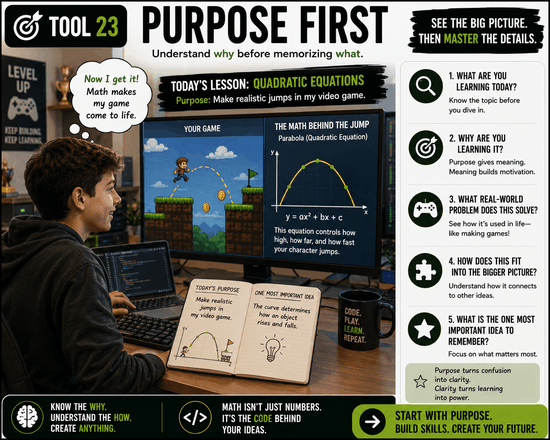
Tool 23 – Purpose First
People are often taught what to do before anyone explains why it matters.
Purpose First encourages teachers, trainers, and managers to begin with the reason behind a lesson, assignment, procedure, or responsibility.
What problem does this solve? Where will it be used? Why should the learner care?
Once the purpose is clear, the details have somewhere to fit.
How can it help? Use it before teaching a lesson, assigning work, introducing a workplace procedure, or explaining a new responsibility.
Why it works: Understanding purpose gives information context and can increase attention, motivation, and understanding.
Tool 24 – Job Understanding System
Giving an employee instructions does not guarantee the employee understood those instructions the way the manager intended.
The Job Understanding System is a three-part approach designed to improve onboarding and everyday job clarity.
It combines reformulation, clear written expectations, and practical checklists so managers have more than one way to make sure important information has been understood.
How can it help? Use it during onboarding, training, cross-training, new assignments, or when job responsibilities change.
Why it works: Checking understanding before problems happen can reduce avoidable mistakes, repeated explanations, and unclear expectations.
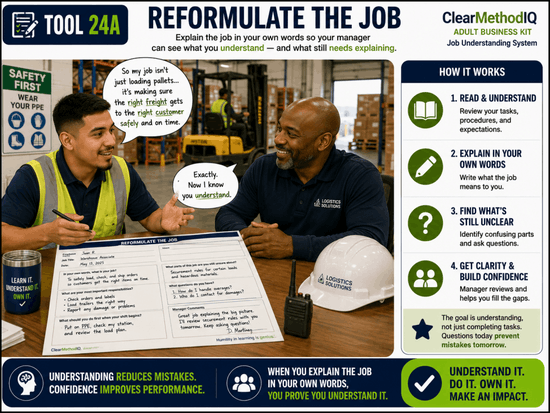
Tool 24A – Reformulate the Job
After receiving job instructions, the employee explains the responsibility back in their own words.
This isn’t meant to embarrass or test the employee.
It gives both the employee and manager an opportunity to compare what was intended with what was actually understood.
How can it help? Use it during onboarding, after training, when assigning new responsibilities, or whenever a task is especially important.
Why it works: Hearing an employee explain the job can quickly expose missing steps or misunderstood expectations before they become workplace problems.
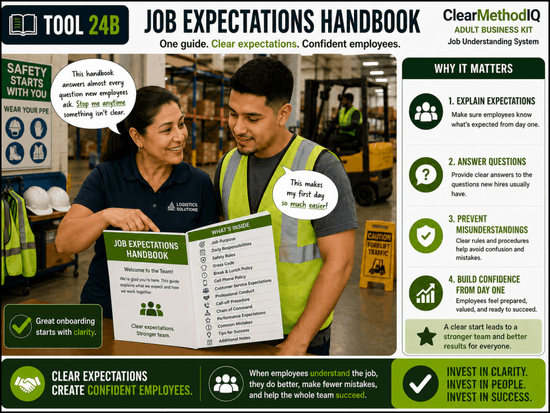
Tool 24B – Job Expectations Handbook
Employees shouldn’t have to guess what their employer expects or depend entirely on remembering everything someone told them during training.
This tool provides one clear place for responsibilities, procedures, expectations, common questions, and other information employees may need to reference later.
How can it help? Give it to employees during onboarding and keep it available after training as an everyday reference.
Why it works: Clear written expectations reduce reliance on memory, assumptions, and inconsistent verbal instructions.
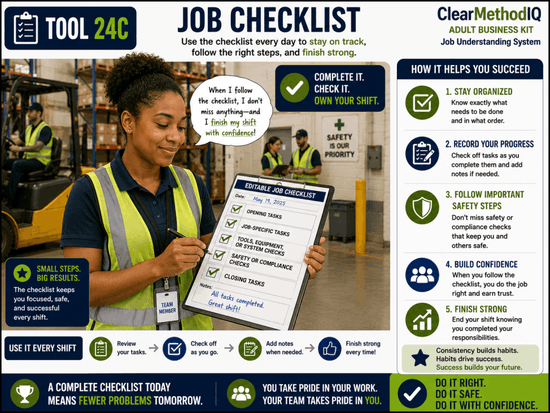
Tool 24C – Editable Job Checklist
Understanding a job doesn’t mean someone will remember every step during a busy day.
This tool lets businesses create editable checklists for specific jobs, routines, procedures, safety requirements, and recurring tasks.
The checklist can be changed as the job changes.
How can it help? Use it during training and as an everyday reference for tasks where consistency matters.
Why it works: Checklists reduce the mental burden of remembering every step and make important procedures easier to complete consistently.
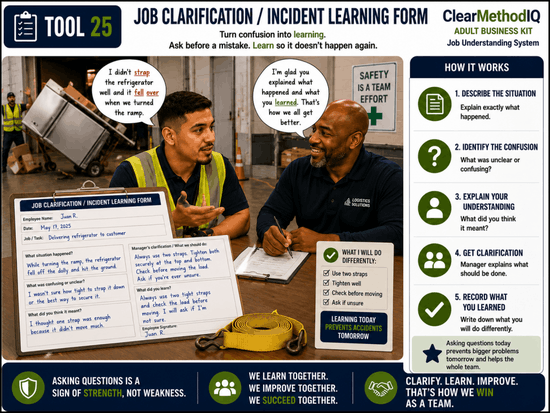
Tool 25 – Job Clarification / Incident Learning Form
When something goes wrong at work, simply deciding who made the mistake may miss the most useful question:
Why did it happen?
This form helps the employee and manager examine what happened, what instructions were given, what the employee understood, what may have been unclear, and what can be changed to reduce the chance of it happening again.
The purpose is accountability and learning, not simply blame.
How can it help? Use it after misunderstandings, mistakes, missed steps, unclear instructions, or workplace incidents where better communication or training could prevent a repeat.
Why it works: Understanding the source of a mistake can improve training, instructions, systems, and future performance.
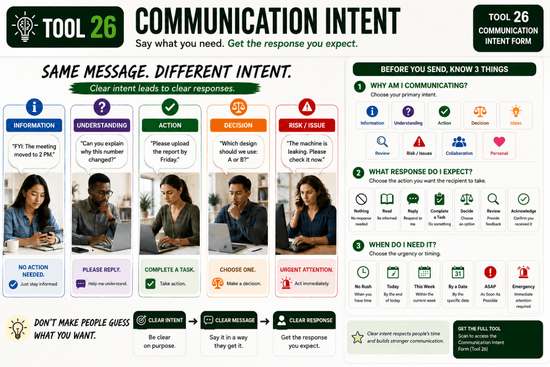
Tool 26 – Communication Intent Guide
Sometimes people understand every word in a message and still misunderstand what the person meant by it.
The Communication Intent Guide helps people clearly identify the purpose behind a message before sending it.
Is this a suggestion? A request? A decision? A question? Feedback? A correction? Something urgent?
It gives people a simple way to label their intent so the reader doesn’t have to guess.
For example:
Intent: Suggestion
“I think we should move the meeting to Friday.”
That feels very different from:
Intent: Decision
“The meeting has been moved to Friday.”
The words may be similar, but the intent changes how the message should be understood.
How can it help? Use it in emails, texts, workplace messages, classroom communication, team discussions, or anywhere tone and intent could easily be misunderstood.
Why it works: Many communication problems are not caused by confusing words. They happen because people interpret the purpose behind those words differently. Making intent visible can prevent unnecessary confusion before it starts.
Tool 1 – Book of Understanding #1 (Blank Page)
This tool asks a person to write down everything they are confused about. Not just the main question. Not just one thing. Everything. They keep writing until they honestly cannot think of anything else they do not understand. No solving yet. No answering yet. No fixing yet. This tool is simply about getting confusion out of the mind and onto paper. Many people feel overwhelmed because confusion stays in their head as one giant fog. This tool helps break that fog into smaller pieces so it can be worked through one part at a time.
Purpose: To help people unload confusion and make it visible.
Why it matters: Confusion often feels worse in the mind than it does on paper.
Tool 2 – Book of Understanding #2(Column Chart)
This tool is used after some understanding has started to happen. The learner goes back to something they were confused about and reflects on what now makes sense, what helped it make sense, and what changed. This helps compare before confusion and after understanding.
Purpose: To help people see progress and understand what helped clarity happen.
Why it matters: People often forget that confusion improves in steps.
Tool 3 – Tree of Inquiry
This tool teaches that one question often leads to an answer, a better question, a deeper question, and more understanding. The learner maps the original question, what helped answer it, and what new questions came next.
Purpose: To show that learning grows through connected questions.
Why it matters: Learning is often not one question and done. Real understanding grows in layers.
Tool 4 – Clarometry (Naming the Fog)
This tool helps people define what kind of confusion they are dealing with. Instead of saying, “I don’t get it,” they become more specific. They may realize they do not understand the word, the steps, why something matters, how the pieces connect, or what assumption they are making.
Purpose: To help people define confusion clearly.
Why it matters: Once confusion has a name, it often becomes easier to solve.
Tool 5 – Learning Habits Self-Study
This tool helps people reflect on when they focus best, where they focus best, what helps them learn, what gets in the way, and what conditions improve understanding. It helps people notice their own learning patterns.
Purpose: To help people learn how they learn.
Why it matters: Not everyone learns best in the same way.
Tool 6 – Reformulation Tracker
This tool helps people reflect on when they focus best, where they focus best, what helps them learn, what gets in the way, and what conditions improve understanding. It helps people notice their own learning patterns.
Purpose: To help people learn how they learn.
Why it matters: Not everyone learns best in the same way.
Tool 7A – AI Practice Prompt Sheet
This tool teaches people how to ask better questions when using AI. It helps them practice asking AI to explain simply, clarify confusion, break things down, give examples, check understanding, and ask follow-up questions.
Purpose: To teach thoughtful AI question asking.
Why it matters: AI can be powerful, but better questions often lead to better learning.
Tool 07B – AI Instructional Handout
This tool teaches people how to ask better questions when using AI. It helps them practice asking AI to explain simply, clarify confusion, break things down, give examples, check understanding, and ask follow-up questions.
Purpose: To teach thoughtful AI question asking.
Why it matters: AI can be powerful, but better questions often lead to better learning.
Tool 07C – AI Calibration Prompt
This tool teaches people how to ask better questions when using AI. It helps them practice asking AI to explain simply, clarify confusion, break things down, give examples, check understanding, and ask follow-up questions.
Purpose: To teach thoughtful AI question asking.
Why it matters: AI can be powerful, but better questions often lead to better learning.
Tool 8 – Class Confusion Survey
This tool lets people share what they are confused about in a safe way. Responses can be anonymous, private, group-based, or collected over time. This helps leaders see patterns, such as many people being confused about the same thing or misunderstandings people may not say out loud.
Purpose: To surface hidden confusion.
Why it matters: People often stay quiet even when confused.
Tool 9 – Confusion Confessions
This tool gives people a safe way to admit, “I don’t understand this.” It may happen privately, in writing, in discussion, or through group activities. The goal is to make honesty about confusion feel normal instead of embarrassing.
Purpose: To normalize honesty about confusion.
Why it matters: Many people fear admitting confusion.
Tool 10 – Lifelong Fog Notebook
This tool gives people a safe way to admit, “I don’t understand this.” It may happen privately, in writing, in discussion, or through group activities. The goal is to make honesty about confusion feel normal instead of embarrassing.
Purpose: To normalize honesty about confusion.
Why it matters: Many people fear admitting confusion.
Tool 11 – Connections Tracker
This tool gives people a safe way to admit, “I don’t understand this.” It may happen privately, in writing, in discussion, or through group activities. The goal is to make honesty about confusion feel normal instead of embarrassing.
Purpose: To normalize honesty about confusion.
Why it matters: Many people fear admitting confusion.
Tool 12 – Assumption Check
This tool helps people stop and ask, “Do I actually know this, or am I guessing?” It helps uncover assumptions, overconfidence, and hidden mistakes.
Purpose: To reduce guessing and improve careful thinking.
Why it matters: Many mistakes begin with false assumptions.
Tool 13 – Perspective Flip
This tool helps people stop and ask, “Do I actually know this, or am I guessing?” It helps uncover assumptions, overconfidence, and hidden mistakes.
Purpose: To reduce guessing and improve careful thinking.
Why it matters: Many mistakes begin with false assumptions.
Tool 14A – Step-by-Step Mastery (Steps & Actions)
This tool helps people stop and ask, “Do I actually know this, or am I guessing?” It helps uncover assumptions, overconfidence, and hidden mistakes.
Purpose: To reduce guessing and improve careful thinking.
Why it matters: Many mistakes begin with false assumptions.
Tool 14B – Step-by-Step Mastery (Parts & Purposes)
This tool helps people understand what the parts are, what each part does, and why each part matters. It is useful when someone needs to understand how something works, not just memorize pieces of it.
Purpose: To help people understand how systems work.
Why it matters: People stop memorizing pieces and begin understanding the system.
.
Tool 15 – Blind Spot Detector
This tool helps people look for what they may be missing. It helps identify skipped steps, missing information, hidden assumptions, and unnoticed gaps.
Purpose: To catch gaps early.
Why it matters: Many mistakes happen because people miss something important.
Tool 16 – Collaboration Bridge
This tool improves communication between people or groups. It helps when teams misunderstand each other, managers and employees are not aligned, students and teachers are missing each other, or departments are not communicating clearly. It improves clarity, feedback, back-and-forth understanding, and shared communication.
Purpose: To reduce communication breakdowns between people.
Why it matters: Many problems are communication problems, not intelligence problems.
Tool 17 – Impossible Made Simple
This tool takes something that feels overwhelming and breaks it into smaller pieces. Instead of saying, “This is impossible,” the person asks, “What is the first small piece?”
Purpose: To reduce overwhelm.
Why it matters: Big problems often become easier when broken down.
Tool 18 – Comfortably Confused Geniuses
This tool shares stories showing that even brilliant people were confused while learning. Confusion often came before success and understanding.
Purpose: To normalize confusion.
Why it matters: Confusion does not mean someone is not smart.
Tool 19: Judgment Override
This tool helps people challenge thoughts like, “I’ll look stupid,” “Everyone else understands,” “I should already know this,” or “I don’t want to ask.” It helps people separate fear from truth.
Purpose: To reduce fear around asking questions.
Why it matters: Fear often blocks learning more than confusion does.
Tool 20: Reformulation
This tool asks two key questions: What do you understand now? What was missing before? The learner compares before confusion and after understanding. It focuses on identifying what changed, what was missing, and what misunderstanding existed earlier.
Purpose: To help people see exactly what gap caused confusion.
Why it matters: Understanding improves when people identify what was missing before.
Tool 21: Anonymous Question QR Poster
This tool lets people ask questions privately by scanning a QR code linked to a form. This helps when people are afraid to ask publicly.
Purpose: To collect honest questions safely.
Why it matters: People often have questions they never say out loud.
Tool 22: Clarity Culture Visual Toolkit
This tool uses posters, reminders, signs, and visual materials that reinforce curiosity, question asking, honesty about confusion, and safe learning environments.
Purpose: To create environments where asking questions feels normal.
Why it matters: Many places say “ask questions,” but do not reinforce that message daily.
Tool 1 – Book of Understanding #1 (Blank Page)
This tool asks a person to write down everything they are confused about. Not just the main question. Not just one thing. Everything. They keep writing until they honestly cannot think of anything else they do not understand. No solving yet. No answering yet. No fixing yet. This tool is simply about getting confusion out of the mind and onto paper. Many people feel overwhelmed because confusion stays in their head as one giant fog. This tool helps break that fog into smaller pieces so it can be worked through one part at a time.
Purpose: To help people unload confusion and make it visible.
Why it matters: Confusion often feels worse in the mind than it does on paper.
Tool 2 – Book of Understanding #2(Column Chart)
This tool is used after some understanding has started to happen. The learner goes back to something they were confused about and reflects on what now makes sense, what helped it make sense, and what changed. This helps compare before confusion and after understanding.
Purpose: To help people see progress and understand what helped clarity happen.
Why it matters: People often forget that confusion improves in steps.
Tool 3 – Tree of Inquiry
This tool teaches that one question often leads to an answer, a better question, a deeper question, and more understanding. The learner maps the original question, what helped answer it, and what new questions came next.
Purpose: To show that learning grows through connected questions.
Why it matters: Learning is often not one question and done. Real understanding grows in layers.
Tool 4 – Clarometry (Naming the Fog)
This tool helps people define what kind of confusion they are dealing with. Instead of saying, “I don’t get it,” they become more specific. They may realize they do not understand the word, the steps, why something matters, how the pieces connect, or what assumption they are making.
Purpose: To help people define confusion clearly.
Why it matters: Once confusion has a name, it often becomes easier to solve.
Tool 5 – Learning Habits Self-Study
This tool helps people reflect on when they focus best, where they focus best, what helps them learn, what gets in the way, and what conditions improve understanding. It helps people notice their own learning patterns.
Purpose: To help people learn how they learn.
Why it matters: Not everyone learns best in the same way.
Tool 6 – Reformulation Tracker
This tool helps people reflect on when they focus best, where they focus best, what helps them learn, what gets in the way, and what conditions improve understanding. It helps people notice their own learning patterns.
Purpose: To help people learn how they learn.
Why it matters: Not everyone learns best in the same way.
Tool 7A – AI Practice Prompt Sheet
This tool teaches people how to ask better questions when using AI. It helps them practice asking AI to explain simply, clarify confusion, break things down, give examples, check understanding, and ask follow-up questions.
Purpose: To teach thoughtful AI question asking.
Why it matters: AI can be powerful, but better questions often lead to better learning.
Tool 07B – AI Instructional Handout
This tool teaches people how to ask better questions when using AI. It helps them practice asking AI to explain simply, clarify confusion, break things down, give examples, check understanding, and ask follow-up questions.
Purpose: To teach thoughtful AI question asking.
Why it matters: AI can be powerful, but better questions often lead to better learning.
Tool 07C – AI Calibration Prompt
This tool teaches people how to ask better questions when using AI. It helps them practice asking AI to explain simply, clarify confusion, break things down, give examples, check understanding, and ask follow-up questions.
Purpose: To teach thoughtful AI question asking.
Why it matters: AI can be powerful, but better questions often lead to better learning.
Tool 8 – Class Confusion Survey
This tool lets people share what they are confused about in a safe way. Responses can be anonymous, private, group-based, or collected over time. This helps leaders see patterns, such as many people being confused about the same thing or misunderstandings people may not say out loud.
Purpose: To surface hidden confusion.
Why it matters: People often stay quiet even when confused.
Tool 9 – Confusion Confessions
This tool gives people a safe way to admit, “I don’t understand this.” It may happen privately, in writing, in discussion, or through group activities. The goal is to make honesty about confusion feel normal instead of embarrassing.
Purpose: To normalize honesty about confusion.
Why it matters: Many people fear admitting confusion.
Tool 10 – Lifelong Fog Notebook
This tool gives people a safe way to admit, “I don’t understand this.” It may happen privately, in writing, in discussion, or through group activities. The goal is to make honesty about confusion feel normal instead of embarrassing.
Purpose: To normalize honesty about confusion.
Why it matters: Many people fear admitting confusion.
Tool 11 – Connections Tracker
This tool gives people a safe way to admit, “I don’t understand this.” It may happen privately, in writing, in discussion, or through group activities. The goal is to make honesty about confusion feel normal instead of embarrassing.
Purpose: To normalize honesty about confusion.
Why it matters: Many people fear admitting confusion.
Tool 12 – Assumption Check
This tool helps people stop and ask, “Do I actually know this, or am I guessing?” It helps uncover assumptions, overconfidence, and hidden mistakes.
Purpose: To reduce guessing and improve careful thinking.
Why it matters: Many mistakes begin with false assumptions.
Tool 13 – Perspective Flip
This tool helps people stop and ask, “Do I actually know this, or am I guessing?” It helps uncover assumptions, overconfidence, and hidden mistakes.
Purpose: To reduce guessing and improve careful thinking.
Why it matters: Many mistakes begin with false assumptions.
Tool 14A – Step-by-Step Mastery (Steps & Actions)
This tool helps people stop and ask, “Do I actually know this, or am I guessing?” It helps uncover assumptions, overconfidence, and hidden mistakes.
Purpose: To reduce guessing and improve careful thinking.
Why it matters: Many mistakes begin with false assumptions.
Tool 14B – Step-by-Step Mastery (Parts & Purposes)
This tool helps people understand what the parts are, what each part does, and why each part matters. It is useful when someone needs to understand how something works, not just memorize pieces of it.
Purpose: To help people understand how systems work.
Why it matters: People stop memorizing pieces and begin understanding the system.
.
Tool 15 – Blind Spot Detector
This tool helps people look for what they may be missing. It helps identify skipped steps, missing information, hidden assumptions, and unnoticed gaps.
Purpose: To catch gaps early.
Why it matters: Many mistakes happen because people miss something important.
Tool 16 – Collaboration Bridge
This tool improves communication between people or groups. It helps when teams misunderstand each other, managers and employees are not aligned, students and teachers are missing each other, or departments are not communicating clearly. It improves clarity, feedback, back-and-forth understanding, and shared communication.
Purpose: To reduce communication breakdowns between people.
Why it matters: Many problems are communication problems, not intelligence problems.
Tool 17 – Impossible Made Simple
This tool takes something that feels overwhelming and breaks it into smaller pieces. Instead of saying, “This is impossible,” the person asks, “What is the first small piece?”
Purpose: To reduce overwhelm.
Why it matters: Big problems often become easier when broken down.
Tool 18 – Comfortably Confused Geniuses
This tool shares stories showing that even brilliant people were confused while learning. Confusion often came before success and understanding.
Purpose: To normalize confusion.
Why it matters: Confusion does not mean someone is not smart.
Tool 19: Judgment Override
This tool helps people challenge thoughts like, “I’ll look stupid,” “Everyone else understands,” “I should already know this,” or “I don’t want to ask.” It helps people separate fear from truth.
Purpose: To reduce fear around asking questions.
Why it matters: Fear often blocks learning more than confusion does.
Tool 20: Reformulation
This tool asks two key questions: What do you understand now? What was missing before? The learner compares before confusion and after understanding. It focuses on identifying what changed, what was missing, and what misunderstanding existed earlier.
Purpose: To help people see exactly what gap caused confusion.
Why it matters: Understanding improves when people identify what was missing before.
Tool 21: Anonymous Question QR Poster
This tool lets people ask questions privately by scanning a QR code linked to a form. This helps when people are afraid to ask publicly.
Purpose: To collect honest questions safely.
Why it matters: People often have questions they never say out loud.
Tool 22: Clarity Culture Visual Toolkit
This tool uses posters, reminders, signs, and visual materials that reinforce curiosity, question asking, honesty about confusion, and safe learning environments.
Purpose: To create environments where asking questions feels normal.
Why it matters: Many places say “ask questions,” but do not reinforce that message daily.
Tool 1 – Book of Understanding #1 (Blank Page)
This tool asks a person to write down everything they are confused about. Not just the main question. Not just one thing. Everything. They keep writing until they honestly cannot think of anything else they do not understand. No solving yet. No answering yet. No fixing yet. This tool is simply about getting confusion out of the mind and onto paper. Many people feel overwhelmed because confusion stays in their head as one giant fog. This tool helps break that fog into smaller pieces so it can be worked through one part at a time.
Purpose: To help people unload confusion and make it visible.
Why it matters: Confusion often feels worse in the mind than it does on paper.
Tool 2 – Book of Understanding #2(Column Chart)
This tool is used after some understanding has started to happen. The learner goes back to something they were confused about and reflects on what now makes sense, what helped it make sense, and what changed. This helps compare before confusion and after understanding.
Purpose: To help people see progress and understand what helped clarity happen.
Why it matters: People often forget that confusion improves in steps.
Tool 3 – Tree of Inquiry
This tool teaches that one question often leads to an answer, a better question, a deeper question, and more understanding. The learner maps the original question, what helped answer it, and what new questions came next.
Purpose: To show that learning grows through connected questions.
Why it matters: Learning is often not one question and done. Real understanding grows in layers.
Tool 4 – Clarometry (Naming the Fog)
This tool helps people define what kind of confusion they are dealing with. Instead of saying, “I don’t get it,” they become more specific. They may realize they do not understand the word, the steps, why something matters, how the pieces connect, or what assumption they are making.
Purpose: To help people define confusion clearly.
Why it matters: Once confusion has a name, it often becomes easier to solve.
Tool 5 – Learning Habits Self-Study
This tool helps people reflect on when they focus best, where they focus best, what helps them learn, what gets in the way, and what conditions improve understanding. It helps people notice their own learning patterns.
Purpose: To help people learn how they learn.
Why it matters: Not everyone learns best in the same way.
Tool 6 – Reformulation Tracker
This tool helps people reflect on when they focus best, where they focus best, what helps them learn, what gets in the way, and what conditions improve understanding. It helps people notice their own learning patterns.
Purpose: To help people learn how they learn.
Why it matters: Not everyone learns best in the same way.
Tool 7A – AI Practice Prompt Sheet
This tool teaches people how to ask better questions when using AI. It helps them practice asking AI to explain simply, clarify confusion, break things down, give examples, check understanding, and ask follow-up questions.
Purpose: To teach thoughtful AI question asking.
Why it matters: AI can be powerful, but better questions often lead to better learning.
Tool 07B – AI Instructional Handout
This tool teaches people how to ask better questions when using AI. It helps them practice asking AI to explain simply, clarify confusion, break things down, give examples, check understanding, and ask follow-up questions.
Purpose: To teach thoughtful AI question asking.
Why it matters: AI can be powerful, but better questions often lead to better learning.
Tool 07C – AI Calibration Prompt
This tool teaches people how to ask better questions when using AI. It helps them practice asking AI to explain simply, clarify confusion, break things down, give examples, check understanding, and ask follow-up questions.
Purpose: To teach thoughtful AI question asking.
Why it matters: AI can be powerful, but better questions often lead to better learning.
Tool 8 – Class Confusion Survey
This tool lets people share what they are confused about in a safe way. Responses can be anonymous, private, group-based, or collected over time. This helps leaders see patterns, such as many people being confused about the same thing or misunderstandings people may not say out loud.
Purpose: To surface hidden confusion.
Why it matters: People often stay quiet even when confused.
Tool 9 – Confusion Confessions
This tool gives people a safe way to admit, “I don’t understand this.” It may happen privately, in writing, in discussion, or through group activities. The goal is to make honesty about confusion feel normal instead of embarrassing.
Purpose: To normalize honesty about confusion.
Why it matters: Many people fear admitting confusion.
Tool 10 – Lifelong Fog Notebook
This tool gives people a safe way to admit, “I don’t understand this.” It may happen privately, in writing, in discussion, or through group activities. The goal is to make honesty about confusion feel normal instead of embarrassing.
Purpose: To normalize honesty about confusion.
Why it matters: Many people fear admitting confusion.
Tool 11 – Connections Tracker
This tool gives people a safe way to admit, “I don’t understand this.” It may happen privately, in writing, in discussion, or through group activities. The goal is to make honesty about confusion feel normal instead of embarrassing.
Purpose: To normalize honesty about confusion.
Why it matters: Many people fear admitting confusion.
Tool 12 – Assumption Check
This tool helps people stop and ask, “Do I actually know this, or am I guessing?” It helps uncover assumptions, overconfidence, and hidden mistakes.
Purpose: To reduce guessing and improve careful thinking.
Why it matters: Many mistakes begin with false assumptions.
Tool 13 – Perspective Flip
This tool helps people stop and ask, “Do I actually know this, or am I guessing?” It helps uncover assumptions, overconfidence, and hidden mistakes.
Purpose: To reduce guessing and improve careful thinking.
Why it matters: Many mistakes begin with false assumptions.
Tool 14A – Step-by-Step Mastery (Steps & Actions)
This tool helps people stop and ask, “Do I actually know this, or am I guessing?” It helps uncover assumptions, overconfidence, and hidden mistakes.
Purpose: To reduce guessing and improve careful thinking.
Why it matters: Many mistakes begin with false assumptions.
Tool 14B – Step-by-Step Mastery (Parts & Purposes)
This tool helps people understand what the parts are, what each part does, and why each part matters. It is useful when someone needs to understand how something works, not just memorize pieces of it.
Purpose: To help people understand how systems work.
Why it matters: People stop memorizing pieces and begin understanding the system.
.
Tool 15 – Blind Spot Detector
This tool helps people look for what they may be missing. It helps identify skipped steps, missing information, hidden assumptions, and unnoticed gaps.
Purpose: To catch gaps early.
Why it matters: Many mistakes happen because people miss something important.
Tool 16 – Collaboration Bridge
This tool improves communication between people or groups. It helps when teams misunderstand each other, managers and employees are not aligned, students and teachers are missing each other, or departments are not communicating clearly. It improves clarity, feedback, back-and-forth understanding, and shared communication.
Purpose: To reduce communication breakdowns between people.
Why it matters: Many problems are communication problems, not intelligence problems.
Tool 17 – Impossible Made Simple
This tool takes something that feels overwhelming and breaks it into smaller pieces. Instead of saying, “This is impossible,” the person asks, “What is the first small piece?”
Purpose: To reduce overwhelm.
Why it matters: Big problems often become easier when broken down.
Tool 18 – Comfortably Confused Geniuses
This tool shares stories showing that even brilliant people were confused while learning. Confusion often came before success and understanding.
Purpose: To normalize confusion.
Why it matters: Confusion does not mean someone is not smart.
Tool 19: Judgment Override
This tool helps people challenge thoughts like, “I’ll look stupid,” “Everyone else understands,” “I should already know this,” or “I don’t want to ask.” It helps people separate fear from truth.
Purpose: To reduce fear around asking questions.
Why it matters: Fear often blocks learning more than confusion does.
Tool 20: Reformulation
This tool asks two key questions: What do you understand now? What was missing before? The learner compares before confusion and after understanding. It focuses on identifying what changed, what was missing, and what misunderstanding existed earlier.
Purpose: To help people see exactly what gap caused confusion.
Why it matters: Understanding improves when people identify what was missing before.
Tool 21: Anonymous Question QR Poster
This tool lets people ask questions privately by scanning a QR code linked to a form. This helps when people are afraid to ask publicly.
Purpose: To collect honest questions safely.
Why it matters: People often have questions they never say out loud.
Tool 22: Clarity Culture Visual Toolkit
This tool uses posters, reminders, signs, and visual materials that reinforce curiosity, question asking, honesty about confusion, and safe learning environments.
Purpose: To create environments where asking questions feels normal.
Why it matters: Many places say “ask questions,” but do not reinforce that message daily.
Tool 1 – Book of Understanding #1 (Blank Page)
This tool asks a person to write down everything they are confused about. Not just the main question. Not just one thing. Everything. They keep writing until they honestly cannot think of anything else they do not understand. No solving yet. No answering yet. No fixing yet. This tool is simply about getting confusion out of the mind and onto paper. Many people feel overwhelmed because confusion stays in their head as one giant fog. This tool helps break that fog into smaller pieces so it can be worked through one part at a time.
Purpose: To help people unload confusion and make it visible.
Why it matters: Confusion often feels worse in the mind than it does on paper.
Tool 2 – Book of Understanding #2(Column Chart)
This tool is used after some understanding has started to happen. The learner goes back to something they were confused about and reflects on what now makes sense, what helped it make sense, and what changed. This helps compare before confusion and after understanding.
Purpose: To help people see progress and understand what helped clarity happen.
Why it matters: People often forget that confusion improves in steps.
Tool 3 – Tree of Inquiry
This tool teaches that one question often leads to an answer, a better question, a deeper question, and more understanding. The learner maps the original question, what helped answer it, and what new questions came next.
Purpose: To show that learning grows through connected questions.
Why it matters: Learning is often not one question and done. Real understanding grows in layers.
Tool 4 – Clarometry (Naming the Fog)
This tool helps people define what kind of confusion they are dealing with. Instead of saying, “I don’t get it,” they become more specific. They may realize they do not understand the word, the steps, why something matters, how the pieces connect, or what assumption they are making.
Purpose: To help people define confusion clearly.
Why it matters: Once confusion has a name, it often becomes easier to solve.
Tool 5 – Learning Habits Self-Study
This tool helps people reflect on when they focus best, where they focus best, what helps them learn, what gets in the way, and what conditions improve understanding. It helps people notice their own learning patterns.
Purpose: To help people learn how they learn.
Why it matters: Not everyone learns best in the same way.
Tool 6 – Reformulation Tracker
This tool helps people reflect on when they focus best, where they focus best, what helps them learn, what gets in the way, and what conditions improve understanding. It helps people notice their own learning patterns.
Purpose: To help people learn how they learn.
Why it matters: Not everyone learns best in the same way.
Tool 7A – AI Practice Prompt Sheet
This tool teaches people how to ask better questions when using AI. It helps them practice asking AI to explain simply, clarify confusion, break things down, give examples, check understanding, and ask follow-up questions.
Purpose: To teach thoughtful AI question asking.
Why it matters: AI can be powerful, but better questions often lead to better learning.
Tool 07B – AI Instructional Handout
This tool teaches people how to ask better questions when using AI. It helps them practice asking AI to explain simply, clarify confusion, break things down, give examples, check understanding, and ask follow-up questions.
Purpose: To teach thoughtful AI question asking.
Why it matters: AI can be powerful, but better questions often lead to better learning.
Tool 07C – AI Calibration Prompt
This tool teaches people how to ask better questions when using AI. It helps them practice asking AI to explain simply, clarify confusion, break things down, give examples, check understanding, and ask follow-up questions.
Purpose: To teach thoughtful AI question asking.
Why it matters: AI can be powerful, but better questions often lead to better learning.
Tool 8 – Class Confusion Survey
This tool lets people share what they are confused about in a safe way. Responses can be anonymous, private, group-based, or collected over time. This helps leaders see patterns, such as many people being confused about the same thing or misunderstandings people may not say out loud.
Purpose: To surface hidden confusion.
Why it matters: People often stay quiet even when confused.
Tool 9 – Confusion Confessions
This tool gives people a safe way to admit, “I don’t understand this.” It may happen privately, in writing, in discussion, or through group activities. The goal is to make honesty about confusion feel normal instead of embarrassing.
Purpose: To normalize honesty about confusion.
Why it matters: Many people fear admitting confusion.
Tool 10 – Lifelong Fog Notebook
This tool gives people a safe way to admit, “I don’t understand this.” It may happen privately, in writing, in discussion, or through group activities. The goal is to make honesty about confusion feel normal instead of embarrassing.
Purpose: To normalize honesty about confusion.
Why it matters: Many people fear admitting confusion.
Tool 11 – Connections Tracker
This tool gives people a safe way to admit, “I don’t understand this.” It may happen privately, in writing, in discussion, or through group activities. The goal is to make honesty about confusion feel normal instead of embarrassing.
Purpose: To normalize honesty about confusion.
Why it matters: Many people fear admitting confusion.
Tool 12 – Assumption Check
This tool helps people stop and ask, “Do I actually know this, or am I guessing?” It helps uncover assumptions, overconfidence, and hidden mistakes.
Purpose: To reduce guessing and improve careful thinking.
Why it matters: Many mistakes begin with false assumptions.
Tool 13 – Perspective Flip
This tool helps people stop and ask, “Do I actually know this, or am I guessing?” It helps uncover assumptions, overconfidence, and hidden mistakes.
Purpose: To reduce guessing and improve careful thinking.
Why it matters: Many mistakes begin with false assumptions.
Tool 14A – Step-by-Step Mastery (Steps & Actions)
This tool helps people stop and ask, “Do I actually know this, or am I guessing?” It helps uncover assumptions, overconfidence, and hidden mistakes.
Purpose: To reduce guessing and improve careful thinking.
Why it matters: Many mistakes begin with false assumptions.
Tool 14B – Step-by-Step Mastery (Parts & Purposes)
This tool helps people understand what the parts are, what each part does, and why each part matters. It is useful when someone needs to understand how something works, not just memorize pieces of it.
Purpose: To help people understand how systems work.
Why it matters: People stop memorizing pieces and begin understanding the system.
.
Tool 15 – Blind Spot Detector
This tool helps people look for what they may be missing. It helps identify skipped steps, missing information, hidden assumptions, and unnoticed gaps.
Purpose: To catch gaps early.
Why it matters: Many mistakes happen because people miss something important.
Tool 16 – Collaboration Bridge
This tool improves communication between people or groups. It helps when teams misunderstand each other, managers and employees are not aligned, students and teachers are missing each other, or departments are not communicating clearly. It improves clarity, feedback, back-and-forth understanding, and shared communication.
Purpose: To reduce communication breakdowns between people.
Why it matters: Many problems are communication problems, not intelligence problems.
Tool 17 – Impossible Made Simple
This tool takes something that feels overwhelming and breaks it into smaller pieces. Instead of saying, “This is impossible,” the person asks, “What is the first small piece?”
Purpose: To reduce overwhelm.
Why it matters: Big problems often become easier when broken down.
Tool 18 – Comfortably Confused Geniuses
This tool shares stories showing that even brilliant people were confused while learning. Confusion often came before success and understanding.
Purpose: To normalize confusion.
Why it matters: Confusion does not mean someone is not smart.
Tool 19: Judgment Override
This tool helps people challenge thoughts like, “I’ll look stupid,” “Everyone else understands,” “I should already know this,” or “I don’t want to ask.” It helps people separate fear from truth.
Purpose: To reduce fear around asking questions.
Why it matters: Fear often blocks learning more than confusion does.
Tool 20: Reformulation
This tool asks two key questions: What do you understand now? What was missing before? The learner compares before confusion and after understanding. It focuses on identifying what changed, what was missing, and what misunderstanding existed earlier.
Purpose: To help people see exactly what gap caused confusion.
Why it matters: Understanding improves when people identify what was missing before.
Tool 21: Anonymous Question QR Poster
This tool lets people ask questions privately by scanning a QR code linked to a form. This helps when people are afraid to ask publicly.
Purpose: To collect honest questions safely.
Why it matters: People often have questions they never say out loud.
Tool 22: Clarity Culture Visual Toolkit
This tool uses posters, reminders, signs, and visual materials that reinforce curiosity, question asking, honesty about confusion, and safe learning environments.
Purpose: To create environments where asking questions feels normal.
Why it matters: Many places say “ask questions,” but do not reinforce that message daily.
posters, creator-focused content, and viral merch.
