
Educator & Parent Implementation Guide
A free, open-source learning program for turning confusion into understanding
Before we Begin
Sometimes our brains naturally understand information right away. We hear it. We see it. It clicks. That is wonderful when it happens. But sometimes it does not. Information may feel confusing, frustrating, disconnected, overwhelming, difficult to explain, hard to remember, or unclear even after someone has taught it. That is normal too. This guide is for those moments.
Many students struggle not because they are incapable, but because they may feel embarrassed to admit confusion, think confusion means they are not smart, not know how to explain what is confusing, fear asking questions, shut down too quickly, make an incorrect assumption, miss an important connection, or pretend to understand when they do not.
Most classrooms understandably spend a great deal of time teaching information and answers. ClearMethodIQ adds another skill: teaching learners what to do when they do not understand.
The goal is not to eliminate confusion. Confusion is part of learning. The goal is to help students recognize it, describe it, investigate it, ask better questions, test their understanding, and gradually turn confusion into clarity.
You do not need to use every tool at once. Some tools may become regular classroom routines. Others may only be useful in certain situations. Use what helps. Adjust what works. Ignore what does not fit.
This is a 100% free, open-source learning program. If you create routines, activities, adaptations, or improvements that help students learn, we invite you to share them with the community.
Confusion is Normal.
People pretend to understand.
Questions feel risky.
Employees stay silent.
Pretending slows teams.
It creates bigger problems later.
This guide helps.
Use what helps. Adjust what works.
Build Comfort with Confusion First
Change the culture before focusing on performance.
Before students can ask better questions, explain their thinking, or solve difficult problems, they first need to feel safe saying, “I do not understand this yet.” Phase 1 helps students separate confusion from shame. The goal is to build a classroom where admitting uncertainty is treated as a normal part of learning rather than evidence of failure.
Confusion is part of learning.
Tool
09
Confusion Confessions & Reframes
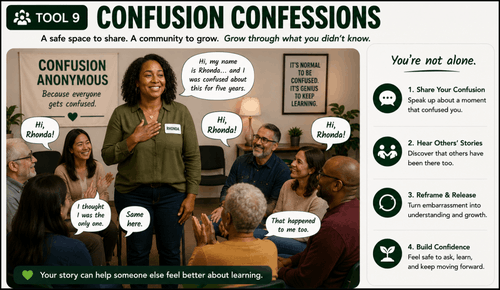
Many students quietly assume everyone else understands. This tool gives a class a structured opportunity to discover that this usually is not true.
Students can anonymously or openly share something that confused them during a lesson, assignment, reading, or learning experience. The teacher can then help the class reframe those moments. Instead of thinking, "I was the only one who didn't get it," students begin to see that confusion is often shared and can be discussed without embarrassment.
This is especially useful early in the school year, after a difficult lesson, or anytime a class becomes unusually quiet about questions.
Try it: Ask students to submit one thing that confused them during the week. Read several examples without identifying anyone and discuss what could make each one clearer.
Best used for: classroom culture, new groups, difficult lessons, weekly reflection, tutoring groups, and students who hesitate to participate.
Tool
18
Comfortably Confused Genius Handouts
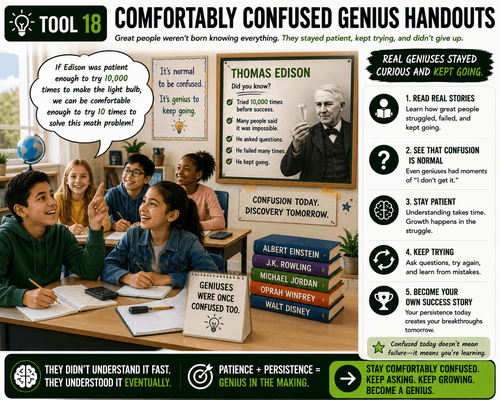
Students can easily develop the belief that intelligent people understand things immediately. That belief makes ordinary learning struggles feel like evidence of low ability.
These handouts challenge that idea through examples, stories, and reminders showing that intelligent and successful people also experience uncertainty, ask basic questions, make mistakes, revise their thinking, and struggle before understanding.
The lesson is not that confusion automatically makes someone intelligent. The lesson is that intelligence and confusion can exist at the same time. A capable student can be confused and still be fully capable of learning the material.
Try it: Use a handout before a difficult unit and ask students what they normally tell themselves when something does not make sense immediately.
Best used for: students who fear mistakes, students who become discouraged quickly, gifted students who are uncomfortable struggling, and classroom culture building.

Want to see visuals for all the other tools?
Every ClearMethodIQ tool has a matching visual example on the Tool Summary page. Visit the Tool Summary to explore all 25 tools with their classroom visuals, descriptions, and ideas for use.
Tool
19
Shame Interrupter Protocol
Sometimes the student already knows the question they want to ask. The problem is that fear stops the question from coming out.
Their internal conversation may sound like: "Everyone else probably understands," "I should already know this," or "What if this is a stupid question?"
Judgment Override teaches students to notice that fear and make a deliberate choice: understanding is more important than protecting the appearance of understanding. Teachers reinforce the tool by responding respectfully to basic questions and by treating the act of identifying confusion as useful information rather than a problem.
Try it: Before taking questions, remind students that a question that feels "too basic" may be exactly the question several people need answered.
Best used for: reluctant question askers, whole-class discussion, tutoring, test preparation, and moments when students appear to be silently struggling.
Tool
01
Book of Understanding #1 (Confusion Dump)
Once students become more comfortable admitting confusion, they need somewhere to put it. The Confusion Dump asks the learner to choose one subject and write down everything about it that feels unclear.
Students should not try to solve anything yet. They list confusing words, definitions, instructions, ideas, examples, steps, assumptions, contradictions, and questions. The first goal is to turn "I don't understand any of this" into a visible list of specific things that can be investigated.
This can reduce the feeling of one giant cloud of confusion and give both the teacher and student a much clearer starting point.
Try it: Give students five uninterrupted minutes to list everything confusing about one topic, then ask them to circle the item that would be most useful to understand first.
Best used for: overwhelming subjects, difficult units, test preparation, tutoring, missing foundational knowledge, and students who say, "I don't even know what to ask."
Tool
04
Clarometry
"I don't understand" is important, but it does not tell the teacher what kind of confusion the learner is experiencing. Clarometry helps students label the source or type of confusion.
A student may realize: "I understand the idea, but not this word," "I understand the first steps, but not why we do this one," "These two explanations seem to contradict each other," or "I think important information is missing."
The goal is to move from vague confusion to specific confusion. Once the learner can describe what is wrong more precisely, it becomes much easier to ask the right question or choose the right kind of help.
Try it: When a student says "I don't get it," ask whether the confusion is about a word, step, instruction, missing connection, assumption, contradiction, purpose, or something else.
Best used for: nearly any subject, tutoring, reading comprehension, math procedures, science concepts, complicated instructions, and independent learning.
Clarometry Field Guide: https://clearmethodiq.com/clarometry-field-guide/
Tool
04A
Clarometry Handouts
The Clarometry Handouts give learners concrete examples of different kinds of confusion so they do not have to invent the language on their own. A student can compare what they are experiencing with examples involving confusing words, missing steps, unclear instructions, assumptions, contradictions, purpose, or missing information.
Educators can use the handouts during a lesson, tutoring session, or one-on-one conversation when a student knows something is wrong but cannot explain it clearly.
Best used for: introducing Clarometry, helping younger learners name confusion, tutoring, reflection, and classroom reference.
Tool
04B
Confusion Mapping
Confusion Mapping helps a learner visually organize several points of confusion around one subject. Instead of treating the entire topic as one problem, students can map where the confusion appears and see how different questions may connect.
This is especially useful when a student has several related questions or when one missing idea may be causing confusion in several other places.
Best used for: complicated units, test review, projects, tutoring, and students who need a visual way to organize what they do and do not understand.
Tool
17
Impossible Made Simple
Sometimes students cannot identify one confusing detail because everything feels confusing at once. Impossible Made Simple helps them break difficult information into smaller pieces that can be examined separately.
A complicated chapter may become several concepts. A difficult process may become a sequence of smaller steps. Once the task is separated, the learner can ask, "Which part do I understand?" and "Where exactly does my understanding stop?"
This changes one overwhelming problem into several smaller problems that can actually be worked through.
Try it: Put a difficult task on the board and have students break it into the smallest useful pieces before anyone attempts to solve it.
Best used for: large assignments, complicated lessons, multi-step problems, projects, studying, and students who become overwhelmed before beginning.
Tool
21
Anonymous Question QR Poster
Some students will participate in a classroom discussion. Others may never raise their hands even when they are completely lost.
The Anonymous Question QR Poster gives those students another path. Students can scan a classroom QR code and privately submit a question or something they do not understand. The teacher can then look for individual questions or patterns across the class.
The important idea is that silence is not evidence of understanding. A quiet room can still contain a great deal of hidden confusion.
Try it: Keep the QR poster visible throughout a unit and remind students periodically that they can use it at any time.
Best used for: shy students, sensitive questions, large classes, lectures, difficult units, and classrooms where students rarely ask questions publicly.
Tool
22
Clarity Culture Visual Toolkit
A classroom culture is not created by saying "ask questions" one time. Students need repeated signals that curiosity, clarification, and admitting uncertainty are genuinely welcome.
This toolkit uses posters, graphics, reminders, and other visual materials to keep those messages visible in everyday learning environments.
The visuals work best when the teacher's behavior supports the same message. A poster saying questions are welcome has little value if students are embarrassed when they actually ask one.
Best used for: year-round classroom reinforcement, hallways, tutoring spaces, libraries, learning centers, and other places where students regularly learn.
Suggested use for Phase 1: Emphasize these tools at the beginning of the school year, during new units, or anytime students seem reluctant to admit confusion. The goal is not to spend weeks talking about confusion. The goal is to establish a simple expectation: we do not have to pretend to understand here.
ORGANIZE AND UNDERSTAND THE CONFUSION
Now that students are becoming more comfortable admitting confusion, the next step is helping them understand what they are confused about. Students begin moving from “I don’t get this” toward “I know where my understanding stops, and I know what I need to investigate next.”
Tool
02
Book of Understanding #2 (Learning Process Tracker)
The Learning Process Tracker helps students see learning as something that changes over time. They record what confused them, what they tried, what questions they asked, what finally helped, and what they understand now.
This is different from simply recording a correct answer. The learner is recording how understanding developed. Over time, patterns may emerge: diagrams may repeatedly help, explaining aloud may make ideas clearer, or missed definitions may repeatedly create problems.
Students are therefore learning the subject while also learning how they learn.
Try it: After resolving a difficult question, ask students not only for the answer but also, "What finally helped this make sense?"
Best used for: long units, tutoring, difficult subjects, reflection, independent learning, and tracking growth over time.
Tool
03
Tree of Inquiry
The Tree of Inquiry teaches students that a good question does not always end an investigation. Sometimes it begins one.
Students start with one question. The answer may create another question, which creates another. A learner might begin with "Why do leaves look green?" and move into questions about chlorophyll, light, energy, and photosynthesis.
The goal is not simply to reach one final answer. It is to experience inquiry as a process and to follow curiosity beyond the surface.
Try it: Begin with one class question and challenge students to create several follow-up questions from the answers they discover.
Best used for: science, history, research, reading, project-based learning, curiosity activities, and independent exploration.
Tool
11
Connections Tracker
New information often becomes easier to understand when students can connect it to something familiar. The Connections Tracker deliberately asks learners to build those links.
A student might connect a scientific idea to something seen at home, a historical event to another period already studied, or a mathematical concept to a real-world situation.
The goal is not to create random associations. It is to give new information meaningful places within what the student already understands.
Try it: Ask: "What does this remind you of?", "Where have you seen something like this?", or "How does this connect to what we learned before?"
Best used for: introducing new concepts, reviewing prior learning, memory, interdisciplinary teaching, and students who understand facts but struggle to see how they fit together.
Tool
12
Assumption Check
Sometimes confusion grows because the learner is building new understanding on top of something that was never actually verified.
Assumption Check teaches students to stop and identify what they are taking for granted. They can ask: What am I assuming is true? Why do I think it is true? What evidence do I have? What should I verify?
This is useful far beyond schoolwork. It builds a thinking habit that can be used in research, problem-solving, media literacy, decision-making, and everyday life.
Try it: Before a complicated problem or project, ask students to identify two things they are currently assuming.
Best used for: research, science, problem-solving, media literacy, debates, projects, and decision-making.
Tool
13
Perspective Flip
Sometimes missing information becomes visible only when the learner changes viewpoints. Perspective Flip asks students to examine an issue temporarily from another person's position.
They consider what that person knows, what they may be missing, what they are trying to accomplish, and what they could interpret differently.
In literature, this might mean examining a conflict from two characters' perspectives. In history, students might compare how different groups experienced the same event. During group work, it can help students understand why classmates interpreted the same instructions differently.
The purpose is not to say every perspective is equally correct. The purpose is to understand how perspective can affect interpretation.
Best used for: literature, history, social studies, disagreements, communication, teamwork, debates, and complex problems.
Tool
14A
Step-by-Step Mastery (Steps & Actions)
Large tasks can feel confusing when an employee or student does not know what comes first. This version of Step-by-Step Mastery turns a complicated task into a sequence of smaller actions that can be understood and completed one at a time.
For educators, this can be used with research projects, multi-step math, experiments, writing assignments, studying, classroom routines, or any task where a learner feels overwhelmed by the whole process.
Try it: Ask the learner to write the first action, then the next, and continue until the full process is visible. Circle the step where understanding becomes unclear.
Best used for: projects, procedures, assignments, studying, multi-step problems, and students who do not know where to begin.
Tool
14B
Step-by-Step Mastery (Parts & Purposes)
Sometimes learners can name the parts of something without understanding why those parts matter. This version helps them identify the important parts of a system, concept, process, or assignment and explain the purpose of each one.
For example, a student may know the sections of a lab report but not understand what each section is supposed to accomplish. Connecting each part to its purpose makes the larger structure easier to understand.
Try it: Have students make two columns: "Part" and "What is its purpose?" If they cannot explain the purpose of a part, that becomes the next question to investigate.
Best used for: systems, processes, writing structures, science, technical learning, procedures, and anything students are memorizing without seeing how the pieces fit together.
Tool
15
Blind Spot Detector
A blind spot is different from ordinary confusion. Sometimes students do not know that something is missing.
The Blind Spot Detector teaches learners to deliberately search for gaps by asking questions such as: What haven't I considered? What could I be missing? Did I skip a step? What am I assuming? What part am I least confident about?
Peer review can also support this process because another person may notice a gap the original student cannot see.
Best used for: tests, essays, presentations, projects, experiments, problem-solving, and final review before submitting work.
Tool
16
Collaboration Bridge
Group work can fail even when everyone is trying. Students may use different definitions, interpret the assignment differently, assume different goals, or believe someone else is responsible for something.
Collaboration Bridge gives students a structured way to compare their understanding before moving forward. Each student or group can explain what they think the task is, what outcome they are trying to produce, what responsibilities they believe they have, and what questions remain.
Differences can then be resolved before they become conflict or poor work.
Best used for: group projects, peer learning, labs, collaborative assignments, student organizations, and classroom conflict.
Suggested use for Phase 2: Choose the tool that matches the problem. If a student cannot explain the confusion, try Clarometry. If everything feels overwhelming, try Impossible Made Simple or Step-by-Step Mastery. If an assumption may be driving the problem, use Assumption Check. If something seems to be missing, try Blind Spot Detector. The tools provide different ways to answer one basic question: where is understanding breaking down?
DAILY UNDERSTANDING CHECKS
Not every student who looks quiet understands. Not every student who nods has clarity. Phase 3 helps teachers and students check understanding regularly instead of waiting until a test, failed assignment, or poor performance reveals a problem.
Tool
06
Reformulate Now Tracker
Reformulation is similar to what happens at a drive-through: you place an order, the employee repeats it back, and you confirm whether what they heard matches what you intended.
Learning can work the same way. After receiving new information, the student explains it back in their own words. The teacher gets to hear what actually reached the learner instead of assuming the message was understood exactly as intended.
A student may have understood most of the lesson but misunderstood one important detail. Reformulation makes that difference visible while there is still time to correct it.
Try it: End a lesson with: "Explain today's main idea as if you were explaining it to someone who missed class."
Best used for: immediately after instruction, demonstrations, directions, discussions, or new concepts.
Tool
08
Class or Team Confusion Survey
Teachers cannot address confusion they never hear about. The Class Confusion Survey gives students a private or low-pressure way to report what remains unclear.
Questions can be very short: What part of today's lesson is still unclear? Where did you lose track? What should I explain again? What are you still unsure about?
The teacher can then look for patterns. If one student is confused, individual support may be appropriate. If many students identify the same issue, that is useful information about the lesson itself.
The survey turns hidden confusion into feedback the educator can actually use.
Best used for: exit activities, weekly checks, difficult units, new material, test preparation, and classrooms where public participation is limited.
Tool
20
Reformulation
Recognizing information is not the same as understanding it. Reformulation asks students to reconstruct an idea in their own words and compare that explanation with the original information.
This can be spoken, written, drawn, demonstrated, or even taught to another student. The important part is that the learner has to explain the idea rather than simply recognize or repeat memorized wording.
If the explanation contains a misunderstanding, that is useful information. It identifies the next piece of confusion.
Try it: After a lesson, ask students to explain the concept without using the textbook's definition.
Best used for: lesson review, reading comprehension, test preparation, tutoring, science and math concepts, and checking deeper understanding.
Suggested use for Phase 3: These tools do not need to become large additional assignments. A reformulation may take 60 seconds. A confusion survey may contain one question. The goal is to create frequent, small opportunities to discover misunderstanding before a test discovers it for you.
LONG-TERM LEARNING, REFLECTION, AND AI SUPPORT
Not every tool is meant for one lesson or one classroom moment. Phase 4 helps students become more independent learners over time. It also includes tools that can support career readiness, vocational learning, student leadership, educator teams, and the transition from school to the workplace.
Tool
05
Learning Habits Self Study
Instead of simply telling students to develop "good study habits," this tool asks them to investigate themselves as learners.
Students examine when and where they concentrate best, what conditions distract them, whether examples or demonstrations help, when repetition matters, when practical application makes something click, and what routines support understanding and memory.
This should not be used to permanently label a student as one "type" of learner. The purpose is experimentation and self-awareness. Students test approaches and notice what actually helps them.
Best used for: study skills, independent learning, tutoring, reflection, older students, and students who repeatedly struggle with how to approach learning.
Tool
07A
AI Practice Prompt Sheet
AI can give learners a low-pressure place to admit that they still do not understand. The AI Practice Prompt Sheet gives students ready-to-use ways to ask for simpler explanations, additional examples, comparisons, practice questions, and step-by-step help.
The goal is to teach students to use AI as a learning assistant rather than simply asking it for an answer. Educators can model prompts such as: "Don't give me the answer yet. Ask me questions to find out what I'm missing."
Best used for: guided AI practice, independent learning, tutoring support, review, and teaching students how to ask better questions.
Tool
07B
AI Instructional Handout
This handout teaches students how to use AI responsibly when they are confused. It emphasizes explaining the confusion, asking follow-up questions, requesting another explanation when needed, and checking important information instead of automatically accepting the first response.
Educators can use it before allowing AI-assisted work so students understand that the purpose is to improve understanding, not to replace thinking or simply produce finished answers.
Best used for: AI orientation, classroom technology rules, homework support, tutoring, and independent learning.
Tool
07C
AI Calibration Prompt
The AI Calibration Prompt is primarily a support tool for shaping how AI responds to a learner. It encourages the AI to slow down, identify what the learner understands and does not understand, ask clarifying questions, and guide the learner toward understanding rather than rushing directly to an answer.
Educators can use it as a starting framework when they want AI interactions to reflect ClearMethodIQ's learning approach.
Best used for: teacher-guided AI activities, tutoring, individualized practice, and creating a more patient question-and-understanding process.
Tool
10
Lifelong Fog Notebook
Education can unintentionally teach students that every question needs an immediate answer. Real learning does not always work that way.
The Lifelong Fog Notebook gives students one place to save questions they cannot answer yet, ideas they want to investigate, things they still find confusing, and discoveries that change their previous understanding.
Students can periodically revisit older entries. A question that seemed impossible months earlier may suddenly make sense. That gives learners visible evidence that understanding changes over time and preserves curiosity that might otherwise be forgotten.
Best used for: journaling, independent learning, research ideas, curiosity projects, enrichment, long-term reflection, and lifelong learning.
Tool
23
Purpose First
Students are often told what they need to learn before anyone explains why it matters. Purpose First reverses that order.
Before introducing a lesson, assignment, procedure, or project, the educator explains the purpose: What problem does this help solve? Where might it be used? Why are we learning it? How does it connect to something students already understand?
Purpose does not automatically make every assignment exciting, but it gives the details somewhere to fit. Students who understand the destination often have an easier time understanding why the individual steps matter.
Try it: Before beginning a unit, spend two minutes answering: "Why are we learning this, and where might someone actually use it?"
Best used for: new units, assignments, projects, difficult procedures, career education, and students who repeatedly ask, "Why do we need to know this?"
Suggested use for Phase 4: These tools work best throughout the school year, during reflection periods, independent learning, projects, technology lessons, journaling, tutoring, and long-term growth activities. Some teachers may use them monthly, some quarterly, and some whenever students are working on independence and self-awareness. The goal is to build stronger learners over time—not just solve one confusing lesson.
